
Seller Playbook 2026
The Ultimate TikTok Shop Seller Guide 2026
Contents
Executive Summary: The Social Commerce Paradigm Shift
E-commerce has moved into a new phase. Traditional marketplace selling is built around shoppers who already know what they want and search for it directly. TikTok Shop changes that pattern by placing products inside entertainment feeds, creator videos, livestreams, and recommendations.
A shopper may not open TikTok with the intention of buying skincare, a water bottle, a supplement, or a household product. The purchase can begin when the product appears naturally in content that already has the viewer's attention. That discovery-based behavior is the core reason TikTok Shop has become a major opportunity for sellers.
Key Takeaways
| Theme | Meaning for Sellers |
|---|---|
| Discovery-driven commerce | Products can sell because the algorithm introduces them to users during normal content consumption. |
| Profitability discipline | Opening a store is only the starting point; fees, commissions, logistics, returns, and samples decide the real margin. |
| Data-led execution | Winning sellers use tools such as Kalodata to evaluate competitors, detect product momentum, and recruit creators who actually drive GMV. |
TikTok Shop vs Amazon vs Shopify: Which Platform Wins in 2026?
The Traffic Acquisition Matrix
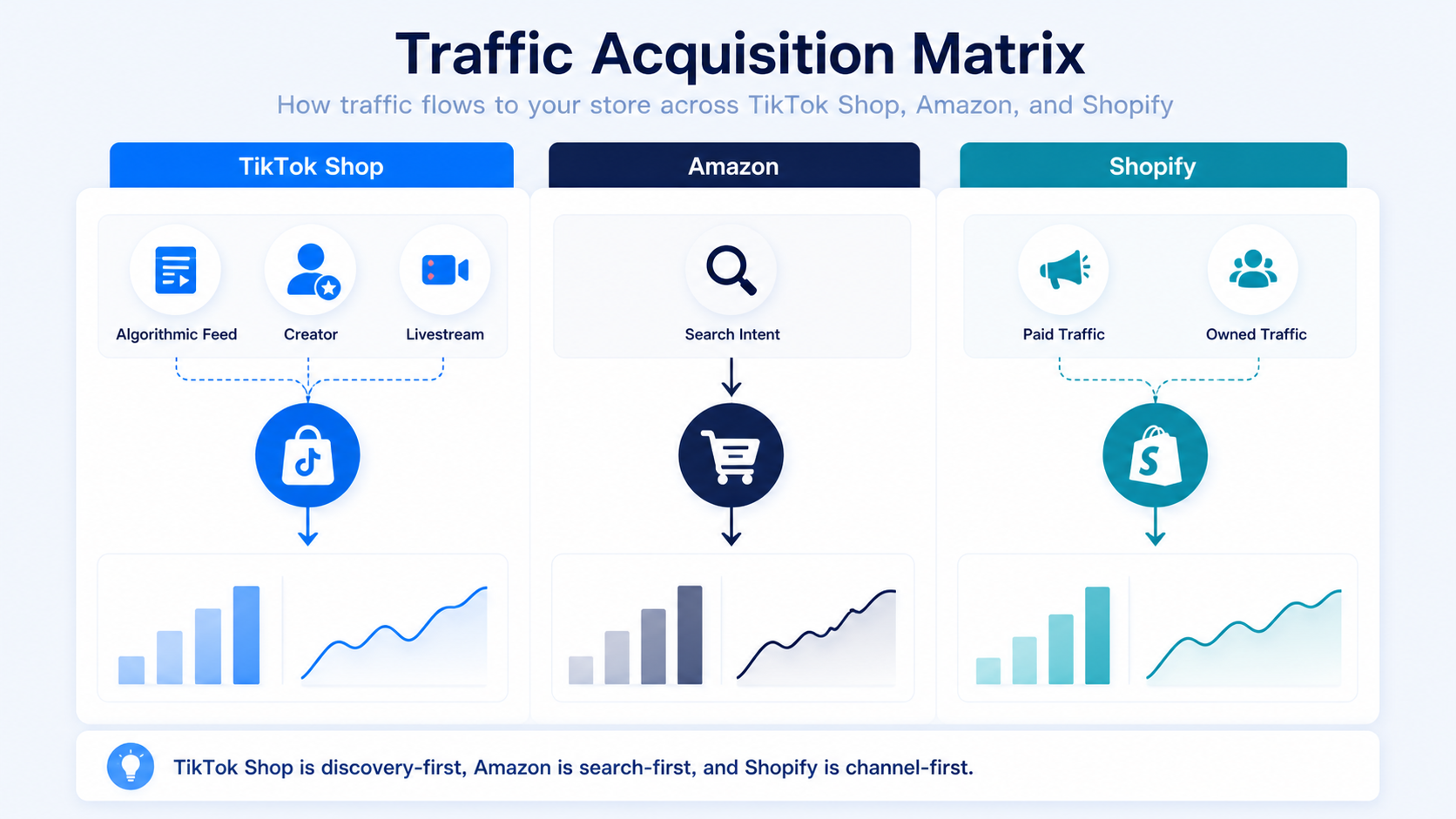
TikTok Shop, Amazon, and Shopify operate on very different traffic models. Amazon benefits from shoppers with active buying intent. Shopify usually requires the brand to acquire visitors through advertising, social media, email, SEO, or other outside channels. TikTok Shop embeds the sales path directly into content distribution.
| Metric | TikTok Shop | Amazon | Shopify |
|---|---|---|---|
| Discovery method | Algorithmic feed and social content | Search-driven product discovery | Traffic from ads and owned channels |
| Organic reach potential | Very strong when content performs | Generally limited by listing position and competition | Usually low without external promotion |
| Customer acquisition cost | Can be low when content and affiliates perform | Moderate | Often high because traffic must be bought or built |
| Viral product potential | High, especially for visual and demonstrable products | Limited compared with social feeds | Depends heavily on paid media and brand reach |
| Content-driven selling | Central to the platform | Not the primary sales mechanism | Usually external to the store |
| Creator affiliate ecosystem | Native and built into the platform | Less central | Usually managed through third-party tools or manual partnerships |
Why TikTok Shop Is Different
Amazon users often arrive close to purchase, with a product need already in mind. TikTok users usually arrive for entertainment. TikTok Shop bridges the space between content consumption and product discovery. That creates a growth motion that is less dependent on search intent and more dependent on creative execution, creator distribution, and algorithmic fit.
Which Products Perform Best?
The strongest TikTok Shop products tend to be easy to show visually and quick to understand. If the benefit can be demonstrated in a short video, the product has a better chance of gaining traction.
| Product Category | TikTok Shop Fit | Amazon Fit |
|---|---|---|
| Beauty and cosmetics | Very high | High |
| Supplements | High, with strict compliance needs | High |
| Fashion | High because styling and try-on videos are natural formats | High |
| Home organization | High because before-and-after demonstrations work well | High |
| Replacement parts | Moderate | Strong for search-intent buyers |
| Industrial supplies | Moderate to low for social discovery | Stronger for search-led purchase |
Want to know if a product is built for TikTok Shop? Use Kalodata to spot demand signals, sales momentum, and the competitive landscape before you commit.
Practical rule: products that can be clearly shown, tested, transformed, compared, or explained in under 15 seconds are better candidates for TikTok Shop.
Onboarding and Legal Compliance
Seller approval is one of the first major friction points. Many rejections come from mismatched documents, tax issues, bank verification failures, or inconsistent seller information. Before submitting an application, sellers should make sure the name, address, tax details, banking details, and business information line up across documents.
Documentation Checklist: Individual Seller
Individual Seller Path
Individuals can sell in supported markets without first forming a registered company. Many sellers start as individuals or sole proprietors and later move into an LLC or other business structure as volume grows.
| Required Item | Purpose |
|---|---|
| Government-issued ID | Verifies identity |
| SSN or ITIN | Supports tax verification |
| Residential address verification | Confirms seller location |
| Personal bank account | Enables payouts |
| Tax information | Required for compliant selling and reporting |
Best Fit for Individual Sellers
- Solo founders and small operators testing a product.
- UGC creators who want to monetize product content.
- Side-hustle sellers starting with limited infrastructure.
- First-time sellers who want to validate demand before forming a company.
Documentation Checklist: Business Seller
Business Entity Path
Business sellers need company-level documentation. This route is better for established brands, agencies, multi-product stores, and teams operating across markets or with more formal infrastructure.
| Required Item | Purpose |
|---|---|
| EIN verification | Confirms business tax identity |
| IRS CP575 or Form 147C | Supports tax record validation |
| LLC or corporate registration | Confirms legal entity status |
| Business bank account | Supports company-level payouts |
| Authorized representative ID | Verifies the person acting for the business |
Category Compliance Matrix
Not every product category has the same approval path. Some are broadly open, some require additional checks, and some may only be available through invitation or special approval.
| Category | Approval Level | Seller Note |
|---|---|---|
| Apparel | Open | Usually accessible with standard seller setup. |
| Home goods | Open | Strong fit for visual demonstration. |
| Pet products | Open | Good content potential, subject to product-specific rules. |
| Beauty products | Restricted | Requires careful compliance around claims and ingredients. |
| Supplements | Restricted | High opportunity but high policy risk around health claims. |
| Baby products | Restricted | Safety and compliance expectations are higher. |
| Luxury goods | Invite only | Likely requires brand authenticity and additional platform approval. |
| Refurbished electronics | Invite only | May require strict validation and seller qualification. |
Choosing the wrong category can make compliance more expensive later. Kalodata helps you evaluate which niches are worth entering before you invest.
Financial Engineering: Understanding TikTok Shop Seller Fees
Every seller eventually asks how much TikTok takes from each order. The answer is not only the platform referral fee. Profitability depends on the full cost stack, including platform fees, creator commissions, payment costs, fulfillment, returns, and sample programs.
Platform Referral Fee
The article uses a 6% base referral fee example. Sellers should always confirm the current fee schedule inside Seller Center because fees can vary by category, market, and promotional period.
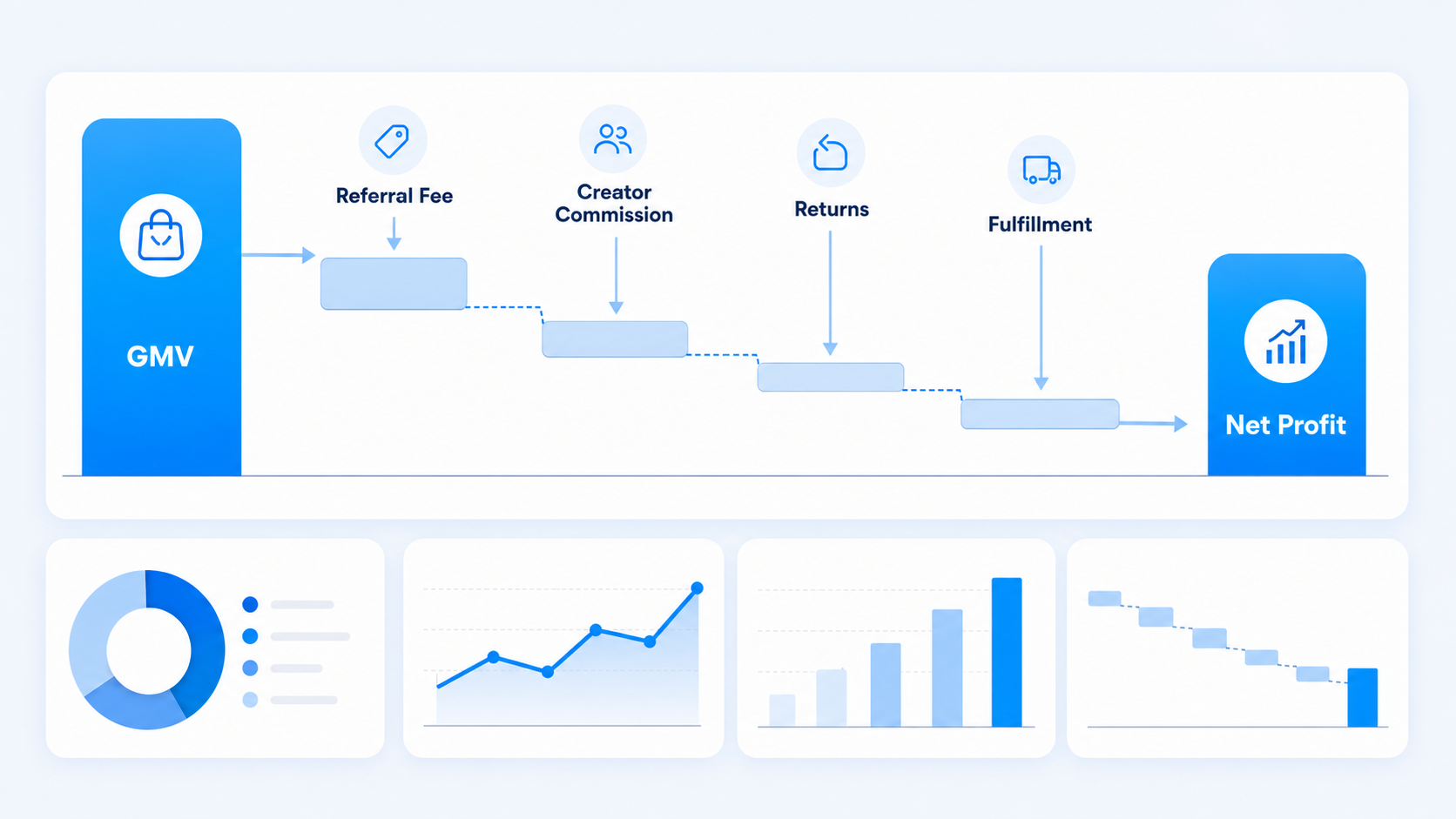
Fee Breakdown Table
| Cost Component | Typical Range or Behavior | Why It Matters |
|---|---|---|
| Referral fee | Example: 6% | Direct platform deduction from transaction value. |
| Creator commission | Often between 5% and 30% | Can make or break unit economics. |
| Payment processing | Variable | Depends on market, payment method, and platform handling. |
| Return fees | Variable | High returns can erase profit even when revenue looks strong. |
| FBT fulfillment costs | Product dependent | Must be modeled by size, weight, category, and storage needs. |
Payout Mechanics
The article notes a minimum payout threshold of \$2. Funds generally become available after an order has cleared the relevant refund or settlement window. Sellers should model cash flow timing, not only final margin, because delayed payouts can affect inventory purchasing and creator programs.
Supported Payout Methods
- Bank transfer.
- Business bank accounts for company sellers.
- Alternative payment providers where supported by region.
Payout Currency
Payouts are generally issued in the currency of the registered marketplace. A United States shop would typically be paid in USD, while a United Kingdom shop would generally be paid in GBP.
Hidden Margin Killers
Sellers often focus on the obvious referral fee while missing the less visible causes of margin erosion. These hidden costs can turn a strong GMV number into weak profit.
- Creator commissions that are too generous for the actual contribution margin.
- Return rates that rise because product claims or creative expectations are misaligned.
- Slow fulfillment that damages customer experience and store metrics.
- Inventory overbuying that ties up cash and increases storage risk.
- Free sample programs that are not measured against creator output and GMV.
Do not stop at GMV. Use Kalodata to find TikTok Shop product opportunities with stronger profit potential.
Building a High-Performing Affiliate Network
The article frames creators as the engine behind many large TikTok Shop stores. Instead of relying mainly on traditional advertising, these sellers build repeatable creator distribution systems.
Open Plan vs Targeted Plan
| Metric | Open Plan | Targeted Plan |
|---|---|---|
| Recruitment speed | Fast | Slower because outreach is selective |
| Creator quality | Mixed | Higher on average |
| Commission control | Lower | Higher |
| Scalability | High | Moderate |
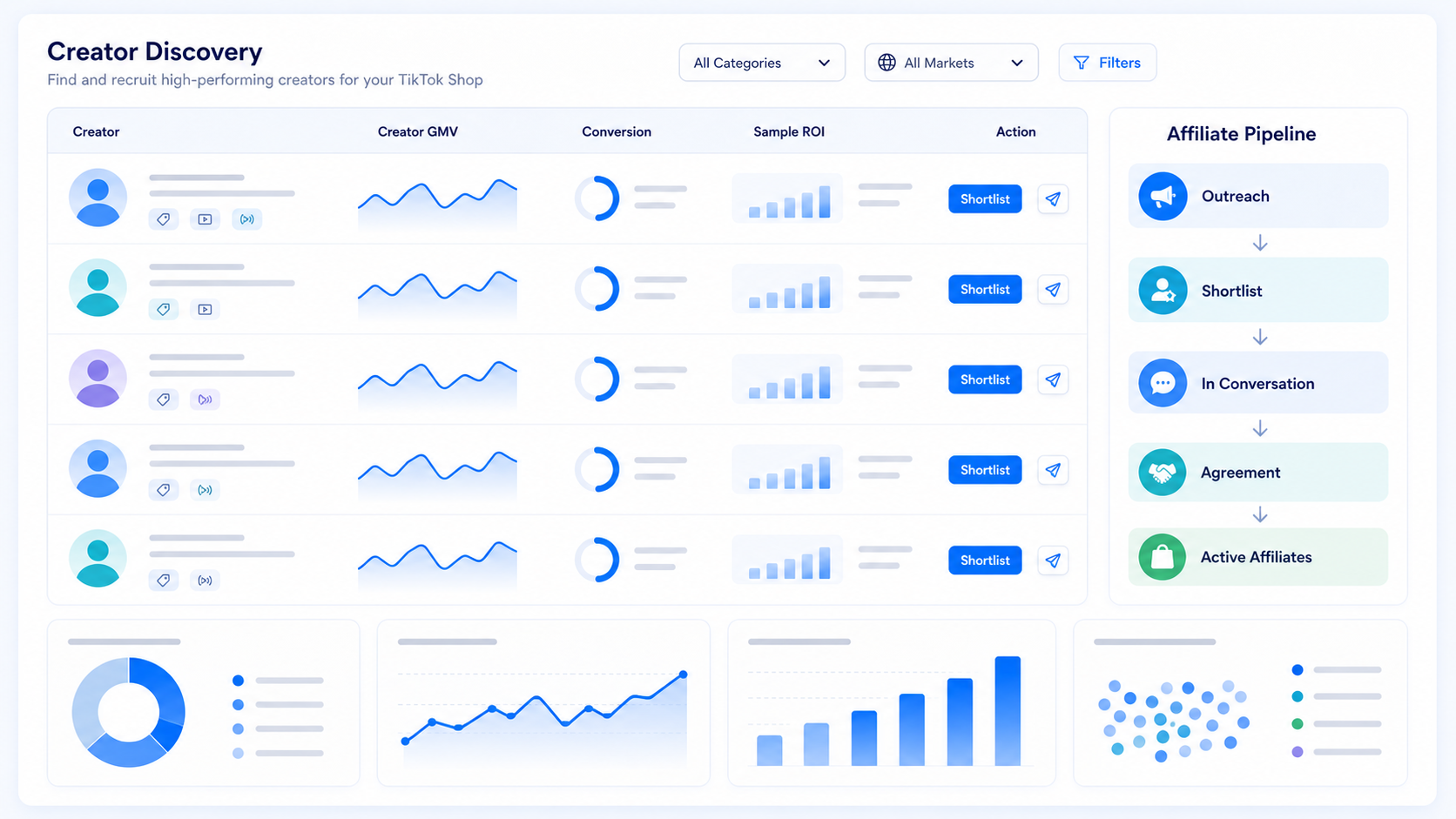
Affiliate Recruitment Framework
Step 1: Identify Winning Creators
Follower count is not enough. Sellers should evaluate creators by commercial performance rather than surface-level popularity.
- GMV generated by the creator.
- Conversion rate from content to purchase.
- Alignment between the creator's audience and the product.
- Consistency of sales performance across videos or campaigns.
Analytics platforms such as Kalodata can help sellers find creators who move product, not just creators who attract attention.
Step 2: Vet Engagement Quality
The article warns sellers not to overvalue likes and followers. Better indicators include the relationship between video views and sales, the creator's ability to sell through products, and evidence of repeated brand partnerships.
| Weak Signal | Better Signal |
|---|---|
| Likes | Video-to-sales ratio |
| Follower count | Product sell-through rate |
| Generic engagement | Repeat brand collaborations and sales history |
Step 3: Launch Sample Programs
Sample programs should be managed like a performance investment. Giving away inventory without deadlines, tracking, or creator qualification can quickly become a margin leak.
- Set a monthly sample budget.
- Track the return from samples in terms of posts, sales, and creator quality.
- Agree on posting deadlines before shipping products.
- Monitor fulfillment and creator follow-through.
- Prioritize creators with proven GMV history.
Industrializing Creator Recruitment
Manual creator outreach can consume enormous time. The article positions data platforms as a way to turn creator recruitment into a repeatable pipeline.
- Discover affiliates who already perform well.
- Analyze creator GMV instead of relying on profile impressions.
- Monitor competitors' creator relationships.
- Track category-level trends and emerging products.
- Build targeted outreach lists instead of messaging hundreds of creators blindly.
Find creators who can actually move products, not just accounts with big follower counts or surface-level engagement.
Creating Viral TikTok Shop Content
Many brands still produce content as if they were making traditional TV commercials. The article argues that this does not usually fit TikTok. TikTok tends to reward content that feels authentic, immediate, and native to the platform.
The 3-Second Hook Formula
The first few seconds decide whether a viewer stays. Effective hooks create curiosity, speak to a problem, introduce a surprise, or show a believable first-person reaction.
- Use a hook that implies the viewer is about to learn something useful.
- Show a moment of surprise or skepticism being resolved.
- Make the product part of a story rather than a standalone sales pitch.
The First-Experience Framework
Consumers trust reactions that feel genuine. A strong content structure can follow the viewer through the first experience with the product.
| Part | Role in the Video |
|---|---|
| Hook | Creates curiosity or frames a problem. |
| Demonstration | Shows the product being used in a concrete way. |
| Result | Reveals the transformation, outcome, or benefit. |
| CTA | Directs the viewer toward the product or purchase path. |
UGC Outperforms Brand Ads
User-generated content often performs better than polished studio advertising because it blends into the platform and feels closer to peer recommendation.
- Unboxing videos.
- Product reviews and first impressions.
- Before-and-after demonstrations.
- Day-in-the-life product integrations.
Viral content should not be a guessing game. Use Kalodata to discover rising videos, products, and creator opportunities while they are still gaining traction.
Live Shopping Blueprint
Livestream shopping adds urgency, interaction, and proof. Strong live sessions combine product education with real-time selling mechanics.
- Clear product demonstrations.
- Limited-time coupons or event-based offers.
- Flash inventory drops.
- Audience questions and answers.
- Real-time testimonials and reactions.
Operational Risk Management
Growth alone is not enough. A store can generate demand and still lose momentum if operational metrics weaken. The article emphasizes that sellers must protect fulfillment quality, customer satisfaction, and platform trust signals.
Understanding Shop Performance Score
The article treats 4.0+ as a healthy SPS reference point and describes scores below 2.5 as a severe restriction zone. Sellers should confirm current thresholds in official TikTok Shop policy and Seller Center.
SPS Drivers
| Metric | Impact | Operational Focus |
|---|---|---|
| Late shipment rate | High | Maintain inventory accuracy and ship on time. |
| Seller-fault returns | High | Improve product quality, sizing, claims, and description accuracy. |
| Order cancellation rate | High | Avoid overselling and supplier instability. |
| Customer complaints | Medium | Resolve issues quickly and reduce recurring causes. |
| Response time | Medium | Set service coverage and standard replies. |
What Happens Below 4.0?
A weaker performance score may reduce affiliate visibility, limit algorithmic exposure, and lower seller credibility. Even if sales are still happening, weaker operational signals can make future growth harder.
What Happens Below 2.5?
At very low performance levels, the article describes severe outcomes such as daily order limits, advertising restrictions, reduced affiliate discoverability, and potential account suspension.
Compliance Traps to Avoid
Automated enforcement can be triggered by risky product claims or misleading creative. Sellers should avoid content that crosses regulated or unsupported claim boundaries.
- Medical claims that the product is not approved to make.
- Income promises or guaranteed financial outcomes.
- Product benefits that cannot be supported.
- Misleading before-and-after results.
FAQ
Can Sellers Use Multiple Warehouses Under One Account?
Yes, depending on regional support and the seller's fulfillment structure. Larger brands may use multiple warehouse locations to reduce delivery time and improve operational performance.
How Do I Build a High-Performing Affiliate Network?
The article recommends a structured system rather than random outreach. Sellers should use data-driven creator selection, manage samples consistently, set competitive but profitable commission structures, and monitor performance continuously.
- Choose creators based on sales evidence.
- Run sample programs with budgets and deadlines.
- Set commission levels that motivate creators without destroying margin.
- Review creator performance over time and adjust the partnership list.
Is TikTok Shop Better Than Amazon?
The article does not frame one platform as universally better. TikTok Shop is stronger for product discovery, viral growth, creator-driven demand, and impulse purchasing. Amazon remains powerful for search intent, repeat buying, and established marketplace behavior. The strongest brands often use both rather than treating them as mutually exclusive.
Final Thoughts: Winning as a TikTok Shop Seller in 2026
The article's final message is that the next phase of e-commerce belongs to discovery-driven commerce. TikTok Shop lets brands place products directly into attention streams before shoppers ever open Amazon or Google.
However, success requires more than opening a shop. Sellers need to understand compliance, control margins, develop creator partnerships, produce content that fits the platform, and use analytics to guide decisions.
The strongest sellers stop relying on guesswork. They track GMV trends, watch competitors, identify promising products, and build scalable affiliate systems using real marketplace data.
Ready to Scale?
The article closes by encouraging sellers to use Kalodata to find product opportunities, recruit high-performing affiliates, and monitor TikTok Shop trends that shape the social commerce market.